Madder 'bout you
Mar. 15th, 2009 07:44 pm![[personal profile]](https://www.dreamwidth.org/img/silk/identity/user.png) wombat1138
wombat1138Yeah, still chasing my madder/Himura/etc. crackpot theory as per this earlier entry. This would be a lot easier if I had any grasp of geography :b but at least things seem to be narrowing down a bit. Maybe.
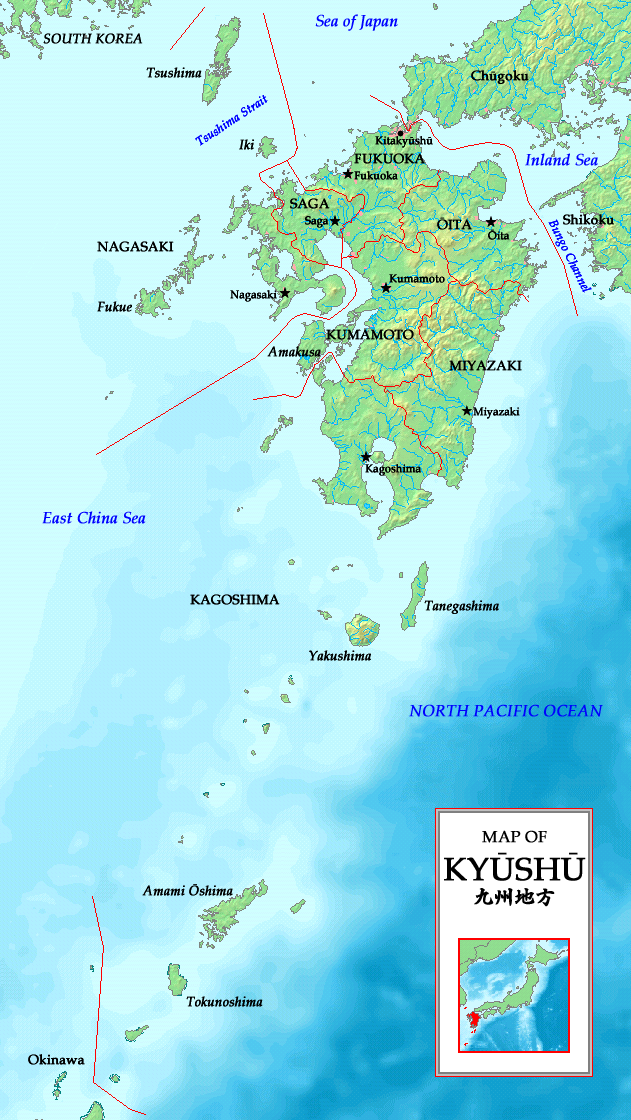
On the guess that Shinta's family might've been hinin-caste hidden Christians, that would probably place them somewhere near Nagasaki, which is in Nagasaki Prefecture on the west of Northern Kyushu. Wikipedia (yeah, I know) currently states in its "akane" article that "[t]he original Hinomaru flag was dyed from using madder from Akane town in Fukuoka Prefecture", although this isn't backed up by the main "Flag of Japan" article-- and so far I'm not seeing any other refs to the *existence* of a so-called "Akane town" in the region. *headdesk*
However, Fukuoka Prefecture is also in Northern Kyushu, even though it doesn't directly border on Nagasaki Prefecture. And the region in between them seems to've been "a major center for Christianity" before the crackdown.
(OTOH, this book cites Yonezawa as a significant and well-known source of madder roots on the same level as the connection of Awa/Tokushima with indigo; unfortunately for the rest of my theory, Yonezawa is in Yamagata Prefecture, up in the northeast of Honshu (the main bow-shaped island; Kyushu is a smaller island down at the southwest end). But interestingly, Yonezawa also seems to've been the stronghold of the Uesugi clan, one of whose best-known members was Uesugi Kenshin-- who was nicknamed "the Dragon of Echigo" whereas his arch-rival was nicknamed "the Tiger of Kai", for a bit of gratuitous Enishi cross-reference.)
The JAANUS entry for akane-iro says:
Meanwhile, need to get back to reading A Song for Nagasaki, a biography of Takashi Nagai which goes into some detail about the background of his wife's family, who managed to covertly preserve their version of Christianity for seven generations during the Shogunate.
Addenda: some interesting book leads, though I'll have to figure out how to request most of them through interlibrary loan unless I can find affordable copies (except for the Whelan, AddAll can't find anything less than $100)--
Higashibaba Ikou. Christianity in Early Modern Japan: Kirishitan Belief and Practice.
Turnbull, Stephen. >The Kakure Kirishitan of Japan: A Study of Their Development, Beliefs and Rituals to the Present Day
ibid. Japan's Hidden Christians, 1549-1999
Whelan, Christal (translator). The Beginning of Heaven and Earth: The Sacred Book of Japan's Hidden Christians.
On the guess that Shinta's family might've been hinin-caste hidden Christians, that would probably place them somewhere near Nagasaki, which is in Nagasaki Prefecture on the west of Northern Kyushu. Wikipedia (yeah, I know) currently states in its "akane" article that "[t]he original Hinomaru flag was dyed from using madder from Akane town in Fukuoka Prefecture", although this isn't backed up by the main "Flag of Japan" article-- and so far I'm not seeing any other refs to the *existence* of a so-called "Akane town" in the region. *headdesk*
However, Fukuoka Prefecture is also in Northern Kyushu, even though it doesn't directly border on Nagasaki Prefecture. And the region in between them seems to've been "a major center for Christianity" before the crackdown.
(OTOH, this book cites Yonezawa as a significant and well-known source of madder roots on the same level as the connection of Awa/Tokushima with indigo; unfortunately for the rest of my theory, Yonezawa is in Yamagata Prefecture, up in the northeast of Honshu (the main bow-shaped island; Kyushu is a smaller island down at the southwest end). But interestingly, Yonezawa also seems to've been the stronghold of the Uesugi clan, one of whose best-known members was Uesugi Kenshin-- who was nicknamed "the Dragon of Echigo" whereas his arch-rival was nicknamed "the Tiger of Kai", for a bit of gratuitous Enishi cross-reference.)
The JAANUS entry for akane-iro says:
This dye was made from the perennial plant madder (Rubia Cordifolia), akane, which grew wild in mountain regions. The roots were collected and left to rest for two or three years. They were then washed, soaked in water, and boiled to extract a bright red dye senryou 染料. Lye, aku 灰汁, was used as a mordant, *baizai 媒済, and white rice added to absorb tannin and other impurities. The cloth or thread to be dyed had to be soaked in the lye and thoroughly dried before dipping in hot dye solution. To obtain a dark color, this process was repeated 20 or 30 times.--random refsplat: a discursion on traditional basic color symbolism that kinda reminds me of Sailor Moon, at least if "purple" is replaced with "pink": "purple for righteousness, green for benevolence, red for propriety, yellow for trust and blue for wisdom."--
Meanwhile, need to get back to reading A Song for Nagasaki, a biography of Takashi Nagai which goes into some detail about the background of his wife's family, who managed to covertly preserve their version of Christianity for seven generations during the Shogunate.
Addenda: some interesting book leads, though I'll have to figure out how to request most of them through interlibrary loan unless I can find affordable copies (except for the Whelan, AddAll can't find anything less than $100)--
Higashibaba Ikou. Christianity in Early Modern Japan: Kirishitan Belief and Practice.
Turnbull, Stephen. >The Kakure Kirishitan of Japan: A Study of Their Development, Beliefs and Rituals to the Present Day
ibid. Japan's Hidden Christians, 1549-1999
Whelan, Christal (translator). The Beginning of Heaven and Earth: The Sacred Book of Japan's Hidden Christians.
![[identity profile]](https://www.dreamwidth.org/img/silk/identity/openid.png)
no subject
on 2009-03-16 11:11 am (UTC)no subject
on 2009-03-16 07:03 pm (UTC)More generally, though, I think villages didn't attempt to rely on cash crops unless they couldn't raise enough rice because of the terrain... generally in rocky, mountainous areas, which fits with the JAANUS description of madder-growing regions.